The First Expedition of Zheng He

In 1405, the Ming Dynasty was in power in China. From 1402 to 1424, the country was ruled by the Yongle Emperor. He was an energetic and ambitious sovereign who came to the throne after a civil war against his nephew.
The year 1405 marked the beginning of the great Chinese maritime expeditions. For the Ming Dynasty, China was considered the center of the world, reinforcing their belief that they were the most powerful rulers on Earth.
A massive fleet, composed of large ships, was assembled. The expedition was organized by the state and financed by the emperor. The goal of this journey was to demonstrate Yongle’s power, establish diplomatic relations with other countries, and control trade routes.
The fleet, both military and commercial, was highly structured. There were “superior” ships carrying admirals, dignitaries, and Zheng He. These ships also transported valuable cargo: silk, porcelain, and Chinese artworks intended as gifts for foreign rulers. Support ships carried troops and supplies such as water, rice, dried meat, and preserved vegetables. Water was replenished at each stop. Specialized vessels handled repairs, reconnaissance, and communication, while fast ships were used as scouts and messengers.
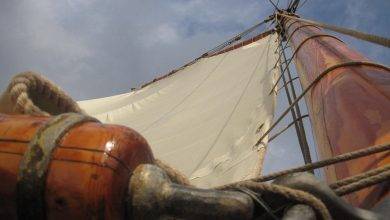
The ships were built with compartmentalized hulls divided into watertight sections—an advanced technology for the time. If one section was damaged, the ship would not immediately sink. They had multiple decks: storage at the bottom, crew in the middle, and command at the top. A massive rudder mounted at the stern allowed maneuvering despite the ships’ size. The sails, made of bamboo and cloth, were easy to adjust.
Chinese sailors already had strong navigation skills. They used the magnetic compass, detailed maritime charts, observation of the stars, and knowledge of monsoon winds—essential for navigating the Indian Ocean. Routes were planned according to the seasons: favorable monsoons for traveling westward and reverse winds for the return journey.
On board were also many diplomats, translators, doctors, and cartographers. Ma Huan was a famous interpreter and translator of Arabic and Chinese. A Chinese Muslim and scholar-official, he authored Yingyai Shenglan, a major historical source on Zheng He’s voyages. He described visited ports such as Calicut, local customs, religions like Hinduism and Islam, traded goods, and daily life in different regions.
Fei Xin, a soldier and observer who also took part in the expedition, left another written account, Xingcha Shenglan. His work provides information about the peoples encountered, landscapes discovered, and maritime routes.
Admiral Zheng He was appointed to lead the fleet, and the voyage lasted two years. The ships departed from China in 1405, from the port of Nanjing. The expedition followed a strategic route beginning in Southeast Asia: Vietnam, Java, and Malacca, which became a key ally of China. At the time, Malacca was an important crossroads between China, India, and the Islamic world.
The fleet continued into the Indian Ocean, stopping at Sri Lanka and along the coast of India. In Sri Lanka, the local king opposed the Chinese, and Zheng He captured him and brought him to China.
The expedition visited numerous kingdoms, ports, and trading cities.
Upon returning, Zheng He brought back foreign ambassadors and exotic goods such as spices and animals unknown in China. Among the spices were pepper, cinnamon, and nutmeg. Animals such as lions and leopards were transported aboard ships to China. Zheng He also brought rare woods, perfumes, and pearls.
This first expedition was a major political and diplomatic success. It strengthened alliances, established lasting relations with ports like Calicut, and asserted a Chinese presence in the Indian Ocean. It also demonstrated that China was capable of sending a vast fleet thousands of kilometers away and controlling maritime routes.